
Offshore wind is becoming a strategic force in the global transition to low-carbon energy. How do we harness that potential and drive sustainable growth beyond the horizon?
Nitin Apte, CEO of Vena Group, recently spoke with Economy Chosun, one of South Korea’s leading business and economic media outlets, about how Vena Energy, the renewable energy arm of Vena Group, is turning ocean winds into a powerful force for sustainable growth.
*Click here to read the original article in Korean. For the English translation, continue reading.
Offshore Wind Power at the Heart of Renewable Transition – Korea’s Maritime Infrastructure Stands Out
Vena Energy, a green energy solutions provider in the Asia-Pacific region, is accelerating its push into Korea’s offshore wind market. Since entering Korea in 2018, the company has expanded its local workforce from just two employees to around 70 and is actively investing in offshore wind projects in Taean and Yokji. Headquartered in Singapore, Vena Energy is developing solar, wind, energy storage, and hydrogen projects in 10 Asia-Pacific countries. During his recent visit to Korea, CEO Nitin Apte shared his insights on the company’s Korea operations and the future of the global renewable energy market. The following is an excerpt from the interview.
Q. Can you introduce Vena Energy?
“Vena Energy is a green energy solutions provider in the Asia-Pacific region. We have accumulated technological expertise and operational experience across various sectors, including solar, onshore wind, offshore wind, and battery energy storage systems. We are also pursuing hydrogen projects in Australia.
We currently operate projects in ten jurisdictions, including Japan, Korea, Taiwan, the Philippines, Thailand, Indonesia, India, Malaysia, Singapore, and Australia. Our headquarters is in Singapore, and we have about 1,200 employees. Our operating capacity has more than tripled in the past seven years to around 4 GW, and we are actively building new projects in eight of the jurisdictions we operate in.”
Q. Please tell us about your current business operations in Korea.
“We opened our first office in Korea at the end of 2018. At the time, we had only two employees, but now we have around 70 working in Seoul and at project sites. We are pursuing both onshore and offshore wind power projects.
Notably, our Taean offshore wind project secured a 500 MW fixed-price FIT contract, and we are also advancing a 384 MW offshore wind development in Yokji.”
Q. Why is Korea positioned as a hub for offshore wind?
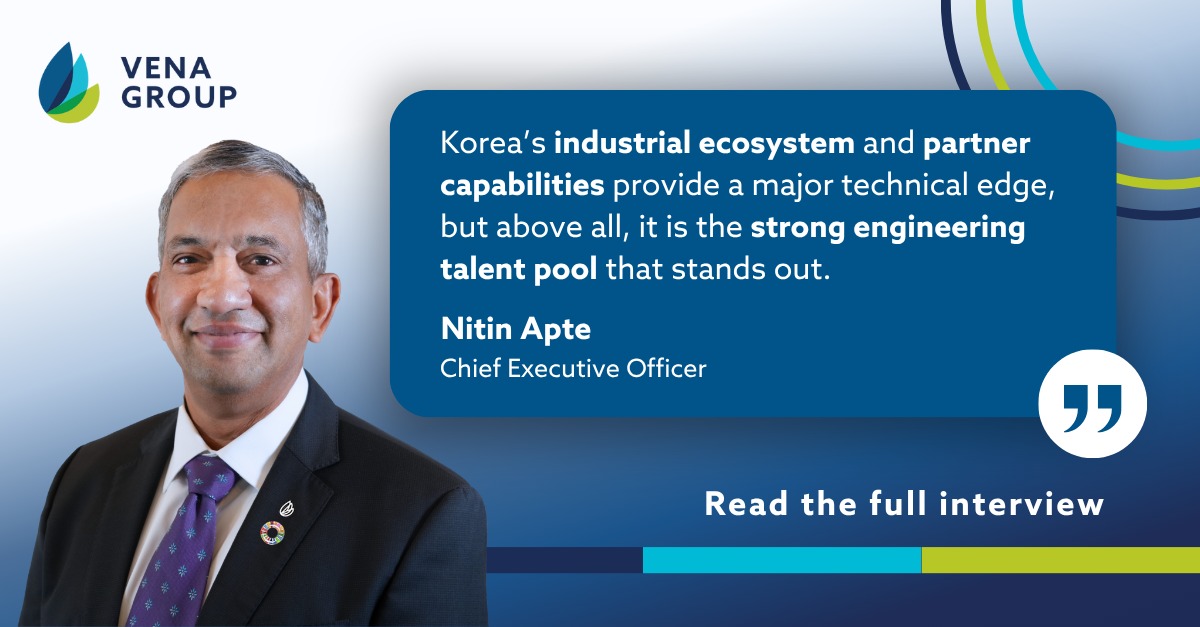
“Korea’s geographical advantage—being surrounded by water on three sides—is significant, but what’s even more important is its strong shipbuilding and marine industry base. Offshore wind power is still in its early stages in Asia, and Korea’s industrial ecosystem and partner capabilities offer a major technical edge.
Moreover, both central and local governments actively support offshore wind development. The recent passage of the Offshore Wind Power Act is a pivotal step in institutionalizing this support.”
Q. What has changed since the Offshore Wind Power Act was passed?
“The passage of the Act itself hasn’t dramatically changed project execution yet. We still need to coordinate with various stakeholders, including central and local governments, local communities, and fisheries groups. At times, we face unexpected challenges due to communication gaps between agencies, even when we have proper permits. We hope the Act will be implemented quickly to unify procedures and establish a one-stop service framework. This institutional support will be key to sustaining Korea’s offshore wind industry.”
Q. Is the electricity generated expected to be supplied to high-demand facilities such as AI data centers in the future?
“Our electricity is supplied to the national grid through Korea Electric Power Corporation(KEPCO)’s subsidiaries. This electricity can be used by high-demand facilities such as AI data centers and large manufacturing plants. With the recent surge in electricity demand driven by AI industries, we believe we can play a crucial role in supporting their power needs.”
Q. What’s the potential of offshore wind power in Korea?
“In addition to the 500 MW project in Taean and the 384 MW project in Yokji, we plan to secure additional projects through upcoming bids. While the exact generation capacity goals are flexible, we see strong potential for continued expansion in Korea.”
Q. What gives Korea’s offshore wind industry its competitive edge?
“Above all, it’s the talent pool. Even without prior offshore wind experience, Korea has many professionals with strong engineering capabilities, making it possible to develop specialized personnel quickly. Most of Vena Energy’s Korean employees are engineers, and while we do bring in external support, having such a strong talent base is a key advantage for the Korean offshore wind sector.”
Q. Renewable energy is vulnerable to natural disasters. How do you address this?
“Before designing any power plant, we conduct rigorous environmental studies and impact assessments over 2–3 years. We prioritize locations with low natural disaster risk. We also operate plants in regions prone to natural disasters—like the Philippines, Japan, and Australia—and implement customized designs and contingency systems for each location.
In the Philippines, for example, we enhanced drainage systems to prepare for typhoons and established protocols for staff evacuation and facility reactivation. We also install typhoon-resistant towers and turbines based on the region’s climate. Moreover, we place the highest value on sustainability. In Taiwan, we established a bird protection education center near a solar power plant located close to a migratory bird habitat and built ecosystem conservation facilities. It’s encouraging to see the local bird population increasing as a result.”
Q. Some say renewable energy is too expensive to install. What’s your view?
“Renewables are long-term infrastructure assets. It’s true that upfront installation costs are high, but they offer stable returns over 20 to 30 years. By reducing equipment costs through technological innovation and collaborating with financial institutions to build long-term investment models, we can address the cost issue. In fact, renewables are already the cheapest energy source in many Asian countries, even when considering total investment.”
Q. Why did you switch from the chemical industry to renewables?
“I spent many years in the chemical industry at companies like General Electric (GE) and SABIC – sectors which might not be considered low-carbon. Over time, I developed a sense of purpose and responsibility to contribute to a low-carbon future. Working in renewables felt personally meaningful. I often tell my team, ‘I’m working to erase my carbon footprint.’ That doesn’t mean other industries are doing wrong—many are making efforts to move toward carbon neutrality.”
Q. What are your future plans for Korea?
“We now have about 70 employees in Korea. Since 2018, we’ve expanded our office three times as we’ve grown. We plan to continue expanding our operations through further hiring, team strengthening, and new project development. We are also exploring a variety of renewable energy businesses in Korea.”